Trending

You have a laptop, two hours and a deadline, and every seat in the city centre café is taken by someone nursing one flat white. Rather than circle the same three chains, it pays to know where a UK city centre actually keeps its quiet. The answer is usually a building that has no reason to hurry you along: a reference library, a museum courtyard, the lounge of a hotel that does not need your table.
Here is how to find those spots, test them quickly, and leave without feeling as though you have overstayed your welcome.
Cafés are designed for turnover. The music, the hard chairs and the queue by the till all exist to keep people moving, which is fine when you want coffee and less fine when you want to concentrate. Places built for lingering are different: libraries, galleries, museums, civic halls, church cafés, hotel lounges, the upper floors of department stores.
Ask one question before you sit down: would anyone mind if I stayed for ninety minutes? If the honest answer is no, that is your spot. If you are not sure, keep walking. Five more minutes of searching usually beats an hour of jostling for a plug socket next to a blender.
Every UK city has at least one, they are free, and nobody expects you to buy anything. The trick is knowing which part of the building to use. The ground floor, with the returns desk and the children's section, can be surprisingly loud, particularly after school. Head upstairs, or ask for the reference or local studies room, where the etiquette is understood without anyone having to explain it.
Big city libraries — Manchester's Central Library, the Library of Birmingham, Leeds Central, Cardiff Central, and the large branches in Glasgow, Edinburgh and Bristol — generally have a range of spaces, from busy café areas near the entrance to silent reading rooms on the upper floors. Smaller branch libraries can be even better, because fewer people think to try them.
The famous ones are not always quiet. A grand museum atrium at midday is a tourist attraction in its own right, and echoing stone makes every conversation sound twice as loud. Smaller city museums and local galleries are a different proposition: many have a courtyard, a sculpture garden or a top-floor room with benches, and mid-morning on a weekday they can be almost empty.
Two useful habits. Check the museum's own café rather than the one nearest the entrance, and look for the rooms at the end of the route, past the gift shop, where visitors rarely linger. Some museums also have study areas open to anyone — the Wellcome Collection in London is a well-known example — and these tend to be quieter than anything with a coffee machine in it.
A hotel lounge is comfortable, usually has decent Wi-Fi, and is half empty for a large part of the afternoon. The window between check-out and check-in — roughly half two to half four on a weekday — is when you will find sofas going spare. Order a coffee or a pot of tea, sit away from reception and the lifts, and work for an hour or two. Avoid breakfast time and the evening, keep calls short and quiet, and do not plug into sockets that belong to the staff. Business hotels near conference centres are the best bet; budget chains are usually too cramped to be comfortable.
Church and cathedral cafés work on the same principle, with the added advantage that silence is part of the deal. Check opening times, be ready to move if a service is starting, and treat the building itself as somewhere quiet rather than somewhere to take a call.
Noise is as much about the hour as the address. The same café that is unbearable at one o'clock is perfectly workable at ten past three. A rough weekday guide:
Weekends flip everything: museums fill with families, while some library branches and business district cafés go strangely quiet. University buildings can be excellent outside term time, though campus libraries usually require membership, so stick to the public café and atrium spaces rather than assuming you can walk into a reading room.
Quiet places stay quiet because people behave. Buy something if there is a counter. Use headphones rather than laptop speakers. Take calls in a stairwell, a corridor or outside. Do not spread your coat, bag and charger across four seats. Take your laptop
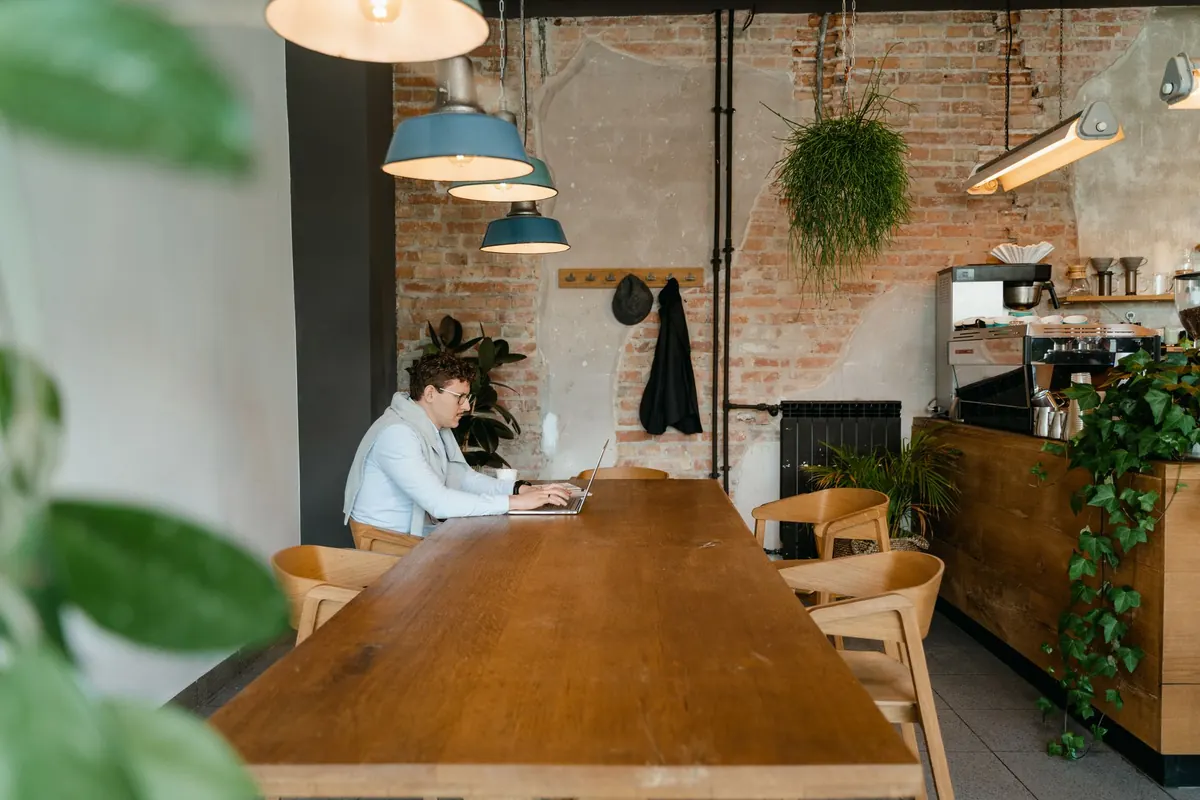
Photo: MART PRODUCTION / Pexels